You have owned your hangar home for a decade. The property has appreciated nicely, and you are ready to make a move, whether that means upgrading to a larger airpark estate, relocating to a different state, or consolidating your aviation real estate holdings. The question is not whether to sell. The question is how.
Selling outright is straightforward. You close, collect a check, and pay your taxes. A 1031 exchange is more complex, but it lets you defer those taxes and reinvest the full proceeds into your next property. Most pilots and aviation property owners understand the concept in general terms, but few have seen the actual numbers side by side.
In this article, we are going to walk through two realistic scenarios for a hangar home sale: one where the owner sells outright and pays taxes, and one where the owner uses a 1031 exchange. Then we will look at what those numbers mean five, ten, and twenty years down the road. The differences are significant.
The Scenario: A Hangar Home in a Florida Airpark
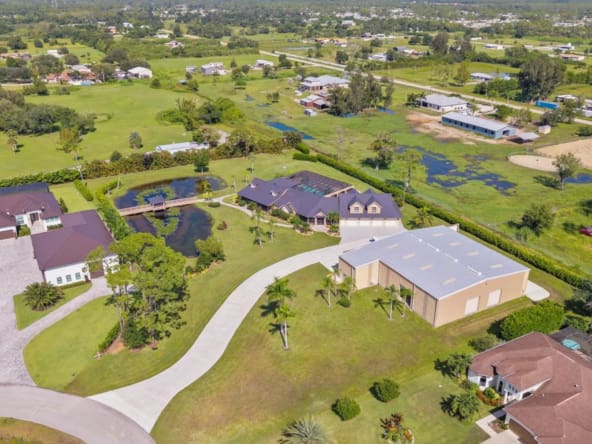
Let us set up a realistic baseline. Our example property owner, a retired airline captain, purchased a hangar home on a deeded airpark lot in Central Florida in 2016 for $425,000. The property includes a 3-bedroom, 2-bath home with an attached 50×40-foot hangar and direct taxiway access to a 4,000-foot paved runway.
Over the past decade, the property has appreciated to a current market value of $750,000. The owner has taken $95,000 in depreciation on the portion of the property used as a rental (the hangar was leased to another pilot for several years). After accounting for improvements and selling costs, the numbers break down like this:
Property Summary
| Item | Amount |
| Original Purchase Price (2016) | $425,000 |
| Capital Improvements (new hangar door, HVAC, avionics shop buildout) | $60,000 |
| Adjusted Cost Basis | $390,000 |
| Depreciation Taken | $95,000 |
| Depreciation-Adjusted Basis | $295,000 |
| Current Market Value | $750,000 |
| Estimated Selling Costs (6%) | $45,000 |
| Net Sale Proceeds | $705,000 |
| Total Taxable Gain | $410,000 |
The total taxable gain of $410,000 includes both the capital appreciation ($315,000) and the depreciation recapture ($95,000). This is the number the IRS is going to want its share of.
Option A: Sell Outright and Pay the Taxes
In a straight sale, the owner closes on the property, collects the net proceeds, and files taxes on the gain. Here is what that looks like:
Tax Breakdown: Selling Outright
| Tax Category | Amount |
| Federal Capital Gains Tax (20% on $315,000) | $63,000 |
| Depreciation Recapture Tax (25% on $95,000) | $23,750 |
| Net Investment Income Tax (3.8% on $410,000) | $15,580 |
| State Income Tax (Florida: 0%) | $0 |
| Total Tax Bill | $102,330 |
| Cash Available for Reinvestment | $602,670 |
The owner walks away with $602,670 in cash after taxes. That is a solid return on a $425,000 investment. But notice what happened: more than $102,000 went to taxes. That is money that will never compound, never generate rental income, and never appreciate.
Also note that this scenario benefits from Florida’s zero percent state income tax. If this same property were in California, New York, or another high-tax state, the total tax bill could easily climb above $140,000.
Option B: Use a 1031 Exchange
In a 1031 exchange, the owner sells the hangar home and reinvests the full net proceeds into a replacement aviation property (or properties) of equal or greater value. A Qualified Intermediary holds the funds throughout the process, and the owner never takes possession of the cash.
1031 Exchange Outcome
| Item | Amount |
| Net Sale Proceeds | $705,000 |
| Taxes Paid at Time of Sale | $0 |
| Capital Available for Replacement Property | $705,000 |
| Qualified Intermediary Fee (typical) | $800 to $1,200 |
| Additional Reinvestment Power vs. Outright Sale | +$102,330 |
The difference is immediate: the owner has $102,330 more to put into their next property. That is not a rounding error. That is a down payment on a second hangar, a significant renovation budget, or the equity gap between a standard hangar home and a premium airpark estate.
The Side-by-Side Comparison
Here is the clearest way to see the impact. Same property, same sale price, two very different outcomes:
| Sell Outright | 1031 Exchange | |
| Sale Price | $750,000 | $750,000 |
| Selling Costs | $45,000 | $45,000 |
| Net Proceeds | $705,000 | $705,000 |
| Taxes Owed Now | $102,330 | $0 |
| Cash for Next Property | $602,670 | $705,000 |
| Extra Buying Power | — | +$102,330 |
The Compounding Effect: What $102,000 Becomes Over Time
The real power of the 1031 exchange is not just the immediate tax savings. It is what that extra capital does when it stays invested in real estate over the long term.
Let us assume the owner reinvests into a replacement aviation property and that property appreciates at a conservative 4% annually (which is well within the historical range for desirable airpark communities). Here is what the additional $102,330 in reinvestment capital grows to over time:
Growth of Additional Capital (4% Annual Appreciation)
| Time Horizon | Value of Extra Capital |
| Year 0 (at exchange) | $102,330 |
| Year 5 | $124,500 |
| Year 10 | $151,500 |
| Year 15 | $184,200 |
| Year 20 | $224,200 |
At the 20-year mark, the decision to use a 1031 exchange instead of selling outright has produced over $224,000 in additional equity from appreciation alone. Factor in rental income generated by that extra capital, and the true advantage is even larger.
The Estate Planning Angle: How the Tax Bill Can Disappear Entirely
Here is where the 1031 exchange goes from “smart” to “extraordinary.” If the owner continues holding the replacement property (or completes additional 1031 exchanges over their lifetime) and eventually passes the property to their heirs, the heirs receive the property at a stepped-up basis.
In simple terms, the stepped-up basis resets the property’s value to its fair market value at the time of inheritance. All of the deferred capital gains, including depreciation recapture, are effectively eliminated. The heirs can sell the property immediately and owe little to no capital gains tax.
In our scenario, that means the $102,330 in deferred taxes from the original exchange is never paid. It is not just deferred. It is gone. For aviation families building generational wealth through airpark properties, this is one of the most powerful financial planning tools available.
When Does Selling Outright Actually Make More Sense?
A 1031 exchange is not always the right move. There are situations where selling outright and paying the tax is the better choice:
- You need the cash. If you are exiting real estate entirely and need liquid funds for retirement, medical expenses, or non-real-estate investments, a 1031 exchange does not help. The proceeds must go into another qualifying property.
- The tax bill is small. If your gain is modest (for example, you bought recently and the property has not appreciated much), the tax savings from a 1031 exchange may not justify the complexity and intermediary fees.
- You cannot find a replacement property in time. The 45-day identification window and 180-day closing deadline are strict. In a niche market like aviation real estate, inventory can be limited. If you cannot find a qualifying replacement property, the exchange fails and taxes become due anyway.
- You are in a low tax bracket. If your overall income puts you in the 0% or 15% long-term capital gains bracket, the tax impact of selling outright may be manageable enough that the flexibility of cash in hand outweighs the deferral.
- You want to change entity structures. The same entity that sells must be the same entity that buys. If you need to restructure ownership (for example, dissolving a partnership), a 1031 exchange may not be feasible.
What Does a 1031 Exchange Cost?
One of the most common questions aviation property owners ask is whether the cost of executing a 1031 exchange eats into the savings. The short answer: not significantly.
A Qualified Intermediary typically charges between $800 and $1,200 for a standard exchange. Some charge additional fees for reverse exchanges or transactions involving multiple replacement properties, which can bring the total to $2,000 to $5,000. There may also be legal fees if your attorney reviews the exchange documents, which is recommended.
Compare that to the $102,330 in taxes our scenario owner would owe on an outright sale. The exchange costs are a fraction of one percent of the tax savings.
Aviation-Specific Considerations for 1031 Exchanges
Aviation real estate has a few quirks that matter when planning a 1031 exchange:
Deeded Land vs. Leased Land
Hangars built on deeded airpark lots are straightforward real property. Hangars on airport-leased land are trickier. If the lease has 30 or more years remaining (including renewals), the IRS treats it as real property and it qualifies for a 1031 exchange. Shorter leases do not. Always verify the lease term before planning an exchange.
Personal Property Inside the Hangar
Since the Tax Cuts and Jobs Act of 2017, personal property (including aircraft, tools, and equipment) no longer qualifies for 1031 exchanges. Only real property qualifies. If your hangar sale includes personal property, that portion must be allocated separately and will be taxed normally. Work with your CPA to ensure the allocation is reasonable and documented.
Limited Inventory, Tight Timelines
Aviation properties are a niche market. Unlike traditional residential real estate, you cannot simply browse hundreds of comparable listings. The 45-day identification window can feel very tight when you are looking for a specific type of property: the right runway length, the right hangar dimensions, the right airpark community. Starting your replacement property search before you list your current property is essential. AV8 Realty’s searchable database of aviation properties across the country can help you identify candidates early so you are prepared when the clock starts.
The Bottom Line
For our scenario owner, selling a $750,000 hangar home outright leaves $602,670 after taxes. Using a 1031 exchange preserves the full $705,000 for reinvestment. That $102,330 difference, compounded over time, can grow to well over $200,000 in additional equity. And with proper estate planning, the deferred taxes may never be paid at all.
A 1031 exchange is not the right choice for every situation, but for aviation property owners who plan to stay invested in real estate, the math is hard to argue with.
If you are considering selling your hangar home and want to understand how a 1031 exchange could work for your specific property, start by exploring replacement properties at av8realty.com. The earlier you identify your next aviation property, the better positioned you will be to execute a successful exchange.
Related Reading on AV8 Realty:
- Top Tax Advantages of a 1031 Exchange for Aviation Property Owners
- The Step-by-Step Guide to a 1031 Exchange for Aviation Real Estate
Disclaimer: This article is for informational purposes only and does not constitute tax or legal advice. The scenarios presented use hypothetical numbers for illustration. Tax rates, rules, and outcomes vary based on individual circumstances. Always consult with a qualified tax professional and Qualified Intermediary before initiating a 1031 exchange.